Knee replacement waiting times in Australian public hospitals
The national median wait for knee replacement in Australian public hospitals was 255 days in 2024–25 — from 24 days at Royal Prince Alfred Hospital to 667 days at Albury Wodonga Health [Wodonga Campus]. The source publishes this surgery as "Total knee replacement".
Reference period 2024–25 (1 July 2024 to 30 June 2025) · released
Across Australia, the median wait for knee replacement in public hospitals was 255 days in 2024–25, from 17987 surgeries. 23.2% of people waited more than 365 days. 128 public hospitals published a median wait for it.
Compare this near you → On the compare page, pick "Total knee replacement" and type your suburb to see the public hospitals within reach, ordered by their published wait. Nothing you type there is kept.
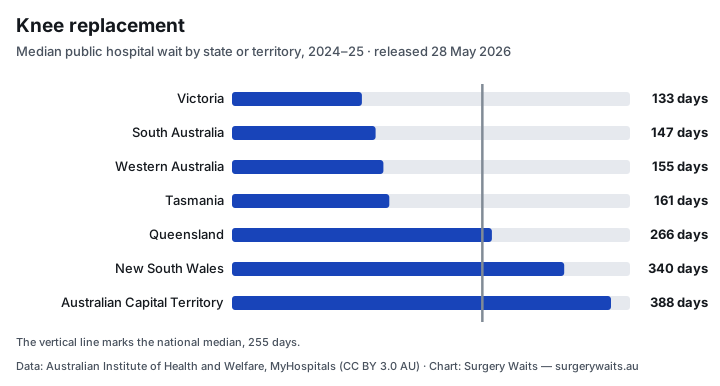
State by state
| Rank | State or territory | Median wait | Waited more than 365 days | Surgeries |
|---|---|---|---|---|
| 1 | Victoria | 133 days | 14.9% | 3839 surgeries |
| 2 | South Australia | 147 days | 14.7% | 1322 surgeries |
| 3 | Western Australia | 155 days | 18.8% | 2087 surgeries |
| 4 | Tasmania | 161 days | 6.8% | 559 surgeries |
| 5 | Queensland | 266 days | 21.5% | 2712 surgeries |
| 6 | New South Wales | 340 days | 31.3% | 7172 surgeries |
| 7 | Australian Capital Territory | 388 days | 53.0% | 202 surgeries |
| unranked | Northern Territory | not published | not published | 94 surgeries |
How the wait has changed
- Australia
- VIC
- SA
- WA
View these numbers as a table
| Reference period | Australia (days) | VIC (days) | SA (days) | WA (days) |
|---|---|---|---|---|
| 2011–12 | 184 | 123 | 173 | 119 |
| 2012–13 | 196 | 141 | 153 | 105 |
| 2013–14 | 194 | 160 | 161 | 83 |
| 2014–15 | 191 | 147 | 212 | 102 |
| 2015–16 | 188 | 148 | 222 | 94 |
| 2016–17 | 195 | 97 | 254 | 100 |
| 2017–18 | 198 | 114 | 273 | 120 |
| 2018–19 | 209 | 111 | 244 | 135 |
| 2019–20 | 223 | 125 | 189 | 126 |
| 2020–21 | 308 | 180 | 318 | 170 |
| 2021–22 | 293 | 163 | 307 | 184 |
| 2022–23 | 308 | 221 | 230 | 213 |
| 2023–24 | 265 | 181 | 167 | 165 |
| 2024–25 | 255 | 133 | 147 | 155 |
Common questions
How long is the wait for knee replacement in a public hospital?
The national median was 255 days in 2024–25 — half of people waited less than that, half waited longer. State medians ranged from 133 days in Victoria to 388 days in Australian Capital Territory.
Which public hospital has the shortest wait for knee replacement?
Of the 128 public hospitals that published a median for 2024–25, Royal Prince Alfred Hospital reported the shortest (24 days) and Albury Wodonga Health [Wodonga Campus] the longest (667 days). A shorter median is not a recommendation — how to read these figures.
How many people waited more than a year?
23.2% of people who had knee replacement in an Australian public hospital in 2024–25 waited more than 365 days.
Cite this page
The national median wait for knee replacement in Australian public hospitals was 255 days in 2024–25, from 24 days at Royal Prince Alfred Hospital to 667 days at Albury Wodonga Health [Wodonga Campus].
Copy-ready citation
SurgeryWaits, "Knee replacement waiting list by state, 2024–25", 2024–25 data released 28 May 2026, https://surgerywaits.au/surgery/knee-replacement/, accessed 28 May 2026.Attribution: SurgeryWaits (https://surgerywaits.au/surgery/knee-replacement/), from Australian Institute of Health and Welfare MyHospitals data, CC BY 3.0 AU. Reference period 2024–25, released 28 May 2026.
Embed the chart
The state comparison is also published as a standalone image at a stable address — the SVG chart — free to embed or link with the attribution below:
<img src="https://surgerywaits.au/charts/knee-replacement.svg" width="720" height="386" alt="Median public hospital waiting time for Knee replacement by state and territory, 2024–25">What is not here
Public hospitals only. Private hospitals do not report to this collection, so their waiting times cannot be compared here.
The source calls this collection "elective surgery". This site calls it planned surgery, because the surgery is planned in advance rather than optional — the methodology explains the wording.